AI Tools · Workflow · Training
The AI tools I use for video, images, audio and training
Knowing many tools means being able to choose the right model for each stage, connect it to a professional process and change course as technology evolves.
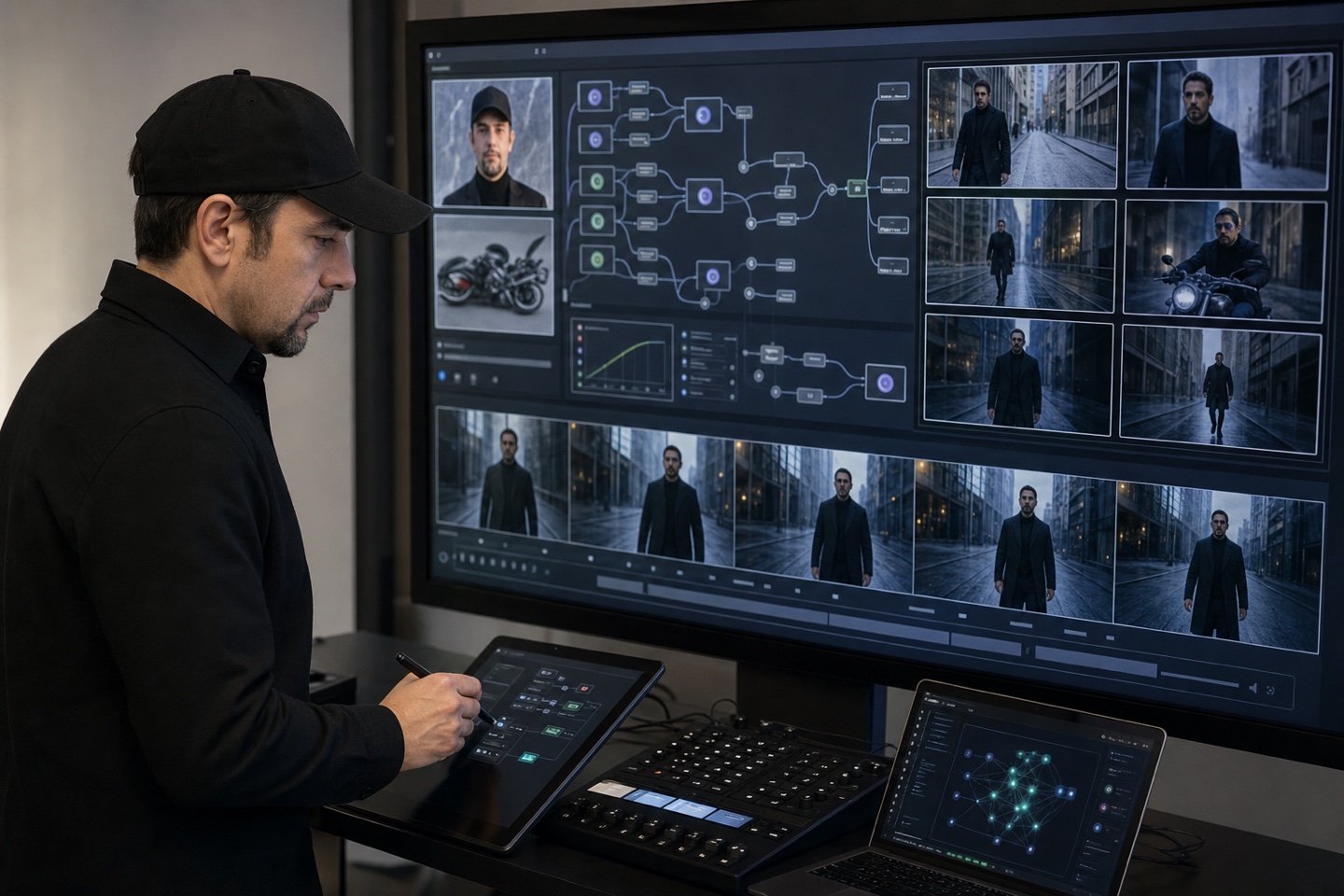
Different tools, one method
Every model is chosen for what it can do within the project.
Real production
Images, video, audio and LLMs enter workflows for directing, editing, training and verification.
Guided adoption
Training connects tools, processes and people to build lasting skills.
Tools do not define professional identity
Runway, Magnific, Krea, Higgsfield and Flora are multimodal ecosystems, also called aggregators: they connect multiple models and production stages. The value lies in recognising which tool can serve an idea and how to integrate it with directing, editing, VFX and sound.
I follow new releases and test them on real projects. This lets me teach lasting selection criteria: quality, control, consistency, time, costs, privacy and responsibility.
Images, concepts and pre-production
For images and concepts, I mainly use GPT Image 2, GPT-Image 2.5, Nano Banana Pro and Nano Banana 2. I combine these with Midjourney, Ideogram and Reve when different visual languages, composition, text rendering or editing methods are needed.
With multimodal ecosystems I also work on storyboards, concepts, references, environments and 3D previews. The goal is to build materials that can guide characters, scenes and shots throughout production.
- GPT Image 2 and GPT-Image 2.5 — generation, editing and reference-based iterations.
- Nano Banana Pro and Nano Banana 2 — concepts, compositions, text and controlled transformations.
- Midjourney, Ideogram and Reve — aesthetic exploration and visual alternatives.
- Runway, Magnific, Krea, Higgsfield and Flora — multimodal ecosystems connecting models and workflow stages.
Video, movement and sound
For video I mainly use Seedance 2 and Seedance 2.5, alongside MiniMax H3, Kling 3.0, Wan 3.0 and Veo 3.1. I create short films, music videos, training content, advertising and hybrid sequences, choosing the model around movement, continuity, references and sound.
ElevenLabs supports voices, sound effects, translations, podcasts and audiobooks in my workflow. HeyGen and Synthesia focus on realistic avatars for entrepreneurs, trainers and content creators. Generation is one part of the process: rhythm, intention, editing and final checks remain essential.
- Seedance 2 and 2.5 — audiovisual scenes, references and multi-shot storytelling.
- MiniMax H3 — multimodal video generation with native audio.
- Kling 3.0, Wan 3.0 and Veo 3.1 — video models offering more control, visual languages and production options.
- ElevenLabs — voice, effects, podcasts, translation and audiobooks.
- HeyGen and Synthesia — realistic avatars and presenter-led content.
LLMs, research, design and coding
ChatGPT, Gemini, Claude, Perplexity, DeepSeek, Kimi and Qwen are not interchangeable. I compare them for research, analysis, writing, reasoning and complex contexts; NotebookLM helps me work with selected sources, while Codex and Claude Cowork extend the work into prototypes, coding and practical tasks.
Using several models also helps reveal limits, omissions and overconfident answers. Source verification and responsibility for the result stay with us.
Training means adoption beyond the demo
A workshop can spark curiosity, but a licence and a list of prompts do not change how people work on their own. I start with real activities, identify friction and opportunities, design exercises around their context and turn what works into a repeatable method.
The crucial step is moving from knowledge to application, then learning to imagine new processes. This takes motivation, room to experiment, discussion of mistakes and people within the organisation who can connect domain expertise with AI's possibilities.
My role is to bridge technology, visual culture and people: make change understandable, help with choices and guide adoption while acknowledging resistance, ethical risks and social consequences.
- Map the work before choosing the tool.
- Start with real cases and observable results.
- Practise verification, independence and transferring the method.
- Build lasting habits beyond the first demonstration.